University Notes Your Online Solution

Do not foud your proper note ? We help you with all the better Notes..

Not Found Your Notes here?

Help Us to add your Subject in University notes! Just contract with Us !

A vast of subject! Select your Catagories !

This Blank space is Only for Your Subject! So fullfill this Gap By your Note!

No Need of Paper!

Just Stay with us and Study Online.. We add all the subject day by day!!

Don't Forget Us We Stay with You!

Just bookmark our page. We are staying with U until your Final destination.

Showing posts with label Fisheries. Show all posts

Aquaculture in Africa & Other Nation

Aquaculture in  Africa•        

There were earlier attempts  mainly from Europe to spread aquaculture in African countries. 


•         However, the presence of extensive flood plains provided environment for growth and reproduction of indigenous species during the rainy season and concentrating them in depressions or marshes during the dry season. •         Due to the nomadic nature of most African communities at the time, the establishment of aquaculture became difficult. 
•         This stimulated the early beginnings of aquaculture in the continent. At the present time, many initiatives for aquaculture development are being started in several countries in Africa. 
•         Tilapia, common carp and catfish are the selected species for culture. 
•         In Sub Saharan Africa, development of aquaculture is fairly recent.
•         Most of the aquaculture systems were introduced in the last 35 years. Trout farming in high altitude areas was introduced in South Africa in 1859 and in Kenya in 1910.
•         Pond culture of fish was introduced after the Second World War. 
•         There was an initial spectacular development with about tilapia 300,000 ponds established in approximately 30 African countries by the end of 1950s. 
Since then fish culture has not made further progress and in many cases it has declined resulting in the abandonment of fish ponds by discouraged farmers. 
This poor performance of aquaculture was attributed to the following : 
1.            Poor husbandry techniques leading to over population of ponds with stunted tilapia fish
2.            The dependency on subsidized extension services and fingerling distribution canters
3.            Poor policies that failed to correctly identify farmers priorities. 
Policy makers assumed that the primary motivation of farmers was food and nutritional security, while for most farmers, the main motivation was income generation
4.            Limitation of resources such as capital, water and feed
5.            Inadequate extension services, 
6.            a lack of quality fingerlings,
7.            insufficient training for extension workers
By the end of the sixties a series of interventions were initiated by the World Bank to revamp the aquaculture industry. 
•         Several measures were introduced such as : 
•         modification of the farming techniques for tilapia in which seed production and 
•         grown-out operations were separated and 
•         the monosex culture of tilapia was introduced 
•         In 1995, Sub Saharan Africa produced 38.8 % of the total volume of fish in Africa from aquaculture (Table 1) which accounted for 40% of the total value. 
•         In terms of the world aquaculture production Sub Saharan Africa produced 0.5% of the total production. 
•         Fish consumption has been decreasing steadily as supply decreases relative to a growing population, from 9 kg per capita in 1990 to 6 kg per capita in currently. 
•         There are many factors that favor the development of aquaculture such as;
–  the underutilized water bodies, 
–  available and inexpensive labour, 
–  high demand for fish and 

–  a climate that favours an all year growing fish. 
Sub-continent of India. 
•         The practice of building water reservoirs of varying sizes as source of water and for religious purposes, started at very early period in this area. 
•         At the beginning, they were not used for fish culture.
•         Subsequently, however, they were initially used to hold fish and later on to culture them. 
  
Indonesia. 
•         The early development of brackish water aquaculture is attributed to this country at the beginning of the 15th century. 
•         This initiative was spread to neighbouring areas including the Philippines, Malaysia, Thailand and southern parts of China (Taiwan). 
Europe. 
•         Aquaculture in Europe also started during early period. 
•         Palaces of the early rulers, as well as temples and monasteries of the religious, were provided with water areas. 
•         Later on, these were used for temporary holding of fish and subsequently, they were used as environment for the culture of fish. 
•         Common carp and trout were recorded as the major species. 
Middle East and Israel. 
•         Although there are existing rivers which can be focal points of development for aquaculture in this region, early historical records did not mention any early aquaculture activities. Religious tradition in this area, however, indicated heavy utilization of fish for food. 
•         Present development show that much progress in aquaculture has occurred in the area especially in Israel. 
•         Here carp and tilapia culture have attained advanced state, and the other countries in the region have initiated aquaculture development programs. 
Japan and Korea. 
•         There is no doubt that aquaculture developed in these two countries during very early period. 
•         Perhaps China had some influences in this development such as in the use of goldfish and carp for culture. 
•         But at same period in their history especially in Japan, the "closed door policy" was enforced in that country. 
•         At that time aquaculture continued to flourish especially in the culture of a very wide variety of species. 
•         This is probably the reason why in that country most any aquatic species of high economic value are subjected to culture - fin fishes, crustaceans, molluscs, other vertebrates and many kinds of marine invertebrates that could be the subject of trade.
•         Development of efficient and high culture technology is also a characteristic of Japanese and Korean aquaculture. 
North America. 
•         There were attempts to develop aquaculture during the 19th century specially aimed at the development of sport fishing. 
•         A book, A Manual of Fish Culture, was published by the United States Commission of Fish and Fisheries in 1897. 
•         This dealt mainly on established hatcheries for the production of seeds to stock game waters but also includes some food species of finfish, oysters, clams, etc. 

Pisciculture or Fish Farming


Fish farming or pisciculture is the principal form of aquaculture, while other methods may fall under mariculture. Fish farming involves raising fish commercially in tanks or enclosures, usually for food. A facility that releases juvenile fish into the wild for recreational fishing or to supplement a species' natural numbers is generally referred to as a fish hatchery. Worldwide, the most important fish species used in fish farming are carp, salmon, tilapia and catfish.
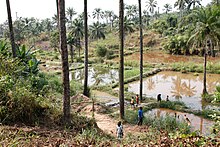
A row of square artificial ponds, with trees on either side

Major Species according to FAO

Top ten freshwater, brackish water and marine cultured fish in 2010 
Freshwater cultureTonnageMaricultureTonnageBrackishwater cultureTonnage
Grass carp4,337,114Atlantic salmon1,421,647Greasy grouper3,677,691
Silver carp4,116,835Large yellow croaker378,622Flathead grey mullet333,322
Catla (Indian carp)3,869,984Salmonids nei270,436Marine fishes nei112,539
Common carp3,444,203Greasy grouper215,028Nile tilapia107,489
Bighead carp2,585,962Sea trout143,751Cyprinids nei100,000
Crucian carp2,217,798Japanese amberjack139,077Barramundi49,234
Nile tilapia1,990,275Gilthead seabream118,212Marble goby34,123
Pangas catfishes nei1,305,277Japanese seabass107,903Tilapias nei23,562
Roho labeo1,167,315European seabass102,538European seabass23,313
Freshwater fishes nei1,080,241Silver seabream73,924Mozambique tilapia17,103
This chart is collected  from Wikipedia

Indoor fish farming

An alternative to outdoor open ocean cage aquaculture, is through the use of a recirculation aquaculture system (RAS). A RAS is a series of culture tanks and filters where water is continuously recycled and monitored to keep optimal conditions year round. To prevent the deterioration of water quality, the water is treated mechanically through the removal of particulate matter and biologically through the conversion of harmful accumulated chemicals into nontoxic ones.
Other treatments such as UV sterilization, ozonation, and oxygen injection are also used to maintain optimal water quality. Through this system, many of the environmental drawbacks of aquaculture are minimized including escaped fish, water usage, and the introduction of pollutants. The practices also increased feed-use efficiency growth by providing optimum water quality (Timmons et al., 2002; Piedrahita, 2003).
One of the drawbacks to recirculation aquaculture systems is water exchange. However, the rate of water exchange can be reduced through aquaponics, such as the incorporation of hydroponically grown plants (Corpron and Armstrong, 1983) and denitrification (Klas et al., 2006). Both methods reduce the amount of nitrate in the water, and can potentially eliminate the need for water exchanges, closing the aquaculture system from the environment. The amount of interaction between the aquaculture system and the environment can be measured through the cumulative feed burden (CFB kg/M3), which measures the amount of feed that goes into the RAS relative to the amount of water and waste discharged.

Aquaculture in Kenya

History of Aquaculture


•         Started 2000 – 1000 B.C
•         China was the cradle of the beginning of aquaculture utilizing mainly the common carp (Cyprinus carpio).
•         no records were available except the narratives handed down from one generation to another especially those found in the seat of power during those periods.
•         No detailed description of aquaculture practices was available during that early period.
•         500 B.C – first record
Photo of dripping, cup-shaped net, approximately 6 feet (1.8 m) in diameter and equally tall, half full of fish, suspended from crane boom, with 4 workers on and around larger, ring-shaped structure in water
•         Fan Lai (Chinese) wrote his book, "The Classic of Fish Culture". 
•         It is the first to record and describe the;
–       structure of ponds, 
–       the method of propagation of the common carp and  – the growth of fry. 
•         500 B.C.- 500 A.D.  - considered the Golden Age of common carp culture in China and in neighbouring countries (where the Chinese people migrated) 
•         progress attained in the techniques of culture 
•         scattered records of the culture systems were made 
•         the use of reservoirs to hold fish was first described in the Indian sub-continent. 
•         500 to 900 A.D. (Tang Dynasty in China)  - discovery of new aquaculture species
•         The reign of the Tang Dynasty is particularly significant in the history of world aquaculture. The Tang emperor in China had the family name of Li which happened to be the common name of the widely-cultivated common carp. 
•         Because of this coincidence, an imperial decree was issued prohibiting the culture as well as other activities connected with this fish. This decree, however, instead of putting a constraint to the development of aquaculture turned to be a blessing in disguise.
•         The Chinese people who were then at the time very much engrossed in fish culture as a source of food and livelihood, looked for other species of fish for pond culture. 
•         This resulted in the discovery of the silver carp, the big-head carp, the grass carp and the mud carp, all very suitable pond culture species. 
•         It was also found that when raised in polyculture in the same pond, these species complement each other by eating different types of food and staying in different environmental strata within the pond. 
•         This led not only in the discovery of new species for culture but also in maximizing the productivity of freshwater pond culture,  900 to 1900 A.D. 
•         900 to 1120 (Sung Dynasty), 
–       The initiative to collect fry of cultivable species seasonally along the rivers was started 
–       Systematic fry collection and dispersal in natural waters was highly developed
–       In India, work by Namasollasa was published. It presented a compilation describing the fattening of fish in reservoirs. 
–       In China, works describing fry transport in bamboo baskets was published.  
1300 to 1650 (Ming Dynasty).  – documentation of culture methods/technologies
–    works describing the complete aquaculture process were detailed. Methods for culturing fry to adult, the structure of ponds, rearing density, polyculture, stocking/catching rotation, application of food and fertilizer and disease control were dealt with in aquaculture works during this period.

–    brackish water aquaculture was recorded as having been started in Indonesia. 

–    In China, a complete Book of Agriculture which included pond fish culture was released. 

1640 to 1910 (Ching Dynasty).  – spread to other places
•         Further detailed description of fish culture methods were emphasized. This included fry production, season of occurrence of fry, differentiation and separation of fry and transport. 


•         In the French Indochinese countries, the waves of Chinese migration had influenced the development of aquaculture. Due to the indigenous species in this area which became of value to the native population, cage culture of siluroids and related species developed independently and became a distinct aquaculture practice in this area uptodate. 


1900-1970 - Expansion in operation and breakthroughs in seed production 

•         This period witnessed worldwide expansion of aquaculture. Easy means of communications and widespread exchange of information through national and international agencies have stimulated the acceleration of the expansion in aquaculture.
 
•         The urgent need for seeds to fill the expanded aquaculture industry resulted in technology breakthroughs in inducing the spawning of cultivable species, the seeds or fry of which were only formerly obtained from wild waters. 
•         In this period the cultivated Asiatic carps and the Indian major carps were induced to spawn under controlled conditions. 

•         Likewise the penaeid shrimp species and the giant freshwater prawns used in culture were also hatched under control in hatcheries

1970 – to date 

•         Continued expansion and selective culture of high value and exportable species and intensification 

•         In this period more species were brought into culture. The industry continued to expand both in area and in quantity of production

•         A new trend to select species that are most profitable to culture was adopted by operators in the industry. 


•         Penaeid shrimps, high value fin fishes (seabass/groupers), seaweeds and related species became important aquaculture items. 

•         As demand and high market value for selected species persisted, high technology methods and intensification of operations became the norm of the industry.

•         There is competition for major markets and maintenance of product quality standards also became a major concern.


•         The major difference between the early forms of aquaculture and much of the aquaculture practiced today is that aquaculture in ancient times involved harvesting immature fish or shellfish and transferring them to an artificially created environment that is favourable to their growth 

History of Aquaculture

Written by.  Kevin Nyabuto